
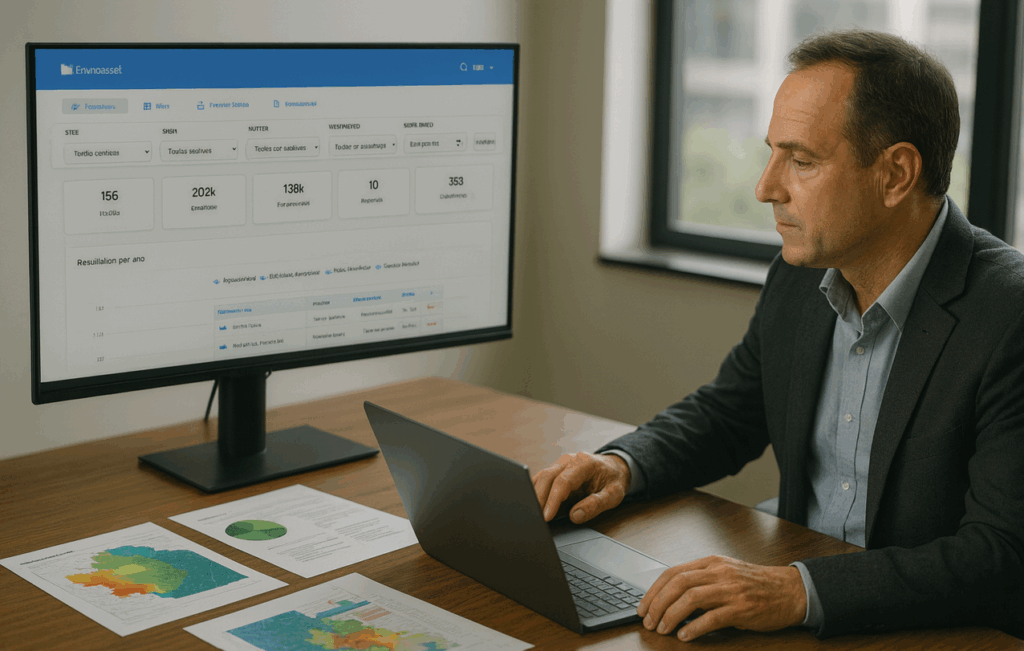
Less than five years ago, it was common to walk into an environmental agency’s analysis room and find a scenario that is almost unimaginable today: decision-makers sitting around a table covered in piles of papers, bulky reports, annexes and opinions accumulating chaotically. Among documents distributed in no apparent order, small teams were manually searching for the crucial information that would define the future of a project. In the midst of this environment, marked by tight deadlines and high responsibilities, crucial decisions were being made.
In this context, the decision-maker needed to locate a few key pieces of information within hundreds or thousands of pages. The completeness of the report, the comprehensiveness of the data, compliance with technical standards and guidelines – all of this is fundamental, but it is often not what defines the final opinion. At the end of the day, it’s certain indicators, graphs, conclusions and strategic sentences that really inform the decision. Finding them, however, was a monumental challenge.
Digitalization has brought important advances. Today, most environmental agencies already accept documentation on digital media, and electronic systems have considerably replaced the physical accumulation of paper. Reports move from paper to PDF files, reducing the risk of misplacement and facilitating specific searches. Despite this, the central problem remains: strategic information is still lost within long, dense documents, and still requires significant effort from the analyst to locate, interpret and synthesize.
The truth is simple: swapping paper for PDF doesn’t transform the decision-making experience – it just changes the medium. The decision-maker still needs to browse through dozens of pages to understand what really matters about an environmental liability, its risks and the plan proposed to mitigate them. It’s not intuitive. It’s not efficient. And it’s certainly not ideal.
The ideal scenario is one in which the decision-maker finds everything they need to know in a clear and objective way. No noise. Without excess. Without the need to dig for information within a complex technical narrative. The entrepreneur, for their part, must be able to present the story of their enterprise – and their data – with clarity, strategy and precision.
This is where an important turning point occurs: entrepreneurs need to take a leading role in their own environmental data. This means going beyond simply complying with legal obligations; it implies understanding that, when well organized and presented, their data can be a decisive ally in the process of licensing or managing contaminated areas. With mastery of the narrative, the entrepreneur presents the environmental agency with exactly what matters: the real diagnosis of the area, the origin and extent of the impacts, the mitigation paths, and how each proposed action guarantees protection for sensitive receptors – thus ensuring the continuity of operations.
To do this, it’s not enough to deliver a report. You need to deliver clarity.
And the most efficient way to achieve this level of clarity is through an Environmental Data Management platform. With this tool, technical communication becomes visual, objective and accessible. Information is no longer “hidden” in a report and is organized in an intuitive way, allowing decision-makers – be they environmental agency analysts, managers, directors or executives – to quickly understand the most critical aspects of the area.
The use of digital platforms, although relatively new in the environmental sector, is already widespread in practically all areas of modern life. We buy tickets, pay for parking, manage bank accounts and even shop in the market through digital applications.
However, we have all experienced platforms that are extremely pleasant – and others that are extremely frustrating. The difference between them comes down to one determining factor: the extent to which the solution has been built with in-depth knowledge of the user’s real problem.
In the environmental sector, this is even more sensitive. With the advance of artificial intelligence, creating a platform that only displays data has become relatively simple. The real challenge lies in knowing which data to show, how to present it and how to drive the user experience so that they really do make better and faster decisions.
That’s why EnviroAsset stands out as a robust and innovative solution for environmental data management. The platform was developed by a multidisciplinary team with in-depth knowledge of the contaminated sites sector, from the technical side to the regulatory needs and expectations of licensing bodies. It is not a generic adapted tool: it is a solution built from the inside out, based on real market pains.
More than that: the platform has been validated over the years by consultants, environmental managers, auditors, entrepreneurs and industry professionals, all of whom have used the tool in practical and decisive contexts. This continuous refinement has allowed EnviroAsset to become a solution that not only organizes data, but actually improves the decision-making process.
By using it, consultants and entrepreneurs succeed:
- Centralize information in a structured way;
- Automatically visualize trends, risks and hotspots;
- Present technical data in a clear and accessible way;
- Significantly reduce response times to environmental agencies;
- Convey security and strategy based on data, not long narratives;
- Strengthen the trust of internal and external stakeholders;
- Put the focus exactly where it should be: on the reality of the area and on the plan for managing risks.
At a time when the environmental sector is demanding ever faster, more informed and transparent responses, the new environmental data management is no longer a trend – it’s a necessity. Organizations that understand this come out ahead: they are better able to dialogue with regulators, reduce uncertainties, plan actions more precisely and, above all, turn data into decisions. Are you ready to take it to the next level?
By:
Hermann Nascimento
Data Science and Environment Specialist
hnascimento@newfields.com.br