
Contents
- Introduction to digital platforms and environmental management
- The role of digital platforms in environmental monitoring
- Sensors and IoT for real-time data collection
- Big Data and predictive analysis for environmental decisions
- Examples of digital platforms in environmental management
- Environmental education and awareness platforms
- Tools for managing natural resources
- Benefits of digitalization in environmental management
- Transparency and community engagement
- Efficient response to environmental disasters
- Challenges and limitations of digital platforms
- Data privacy and security
- Digital inclusion and unequal access
- The future of digital platforms in environmental sustainability
- Conclusion: innovate responsibly
- Comparative table: Digital technologies in environmental management
- FAQ – Frequently Asked Questions
Introduction to digital platforms and environmental management
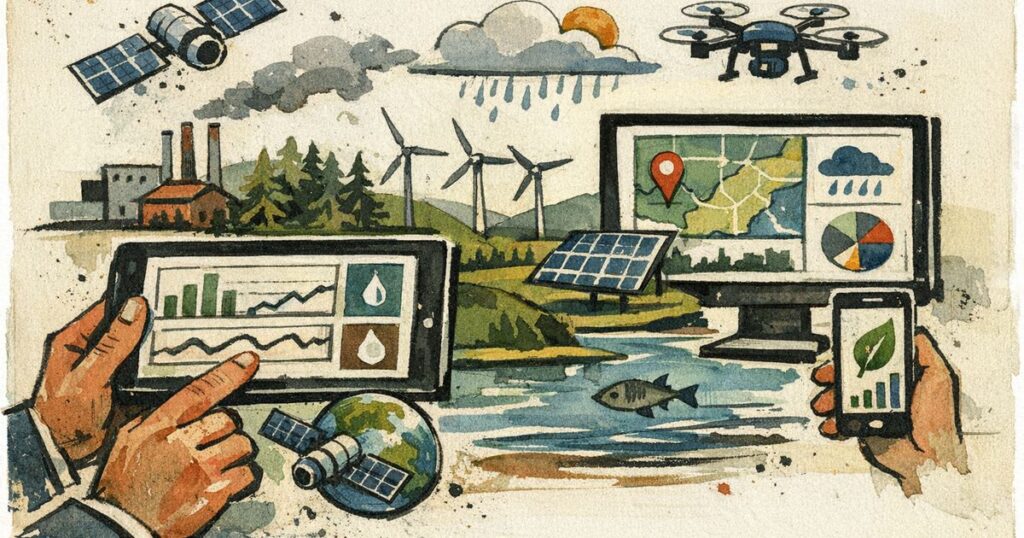
In recent years, digital environmental management platforms have profoundly transformed the field of environmental management. These platforms integrate technologies ranging from connected sensors to complex data analysis systems. They promote a significant change in the way we monitor, evaluate and manage natural resources and human impacts on the environment.
Previously, environmental management relied on manual methods and fragmented data, leading to delays and inaccuracies. Today, digital environmental management platforms offer a precise, integrated and real-time view of ecosystems and their impacting processes, expanding response and planning capacity.
These platforms are fundamental tools for governments, companies, NGOs and local communities, enabling the transparent collection, processing and dissemination of relevant environmental information.
This article details the role of digital environmental management platforms, presenting the technologies involved, concrete applications, benefits, challenges and future prospects for global sustainability.
The role of digital platforms in environmental monitoring
Sensors and IoT for real-time data collection
An essential foundation of digital environmental management platforms is the use of the Internet of Things (IoT) and smart sensors for continuous monitoring. These devices are installed at strategic points to capture environmental data, transforming natural observations into digitalized and easily analyzable information.
Main characteristics of these sensors and IoT:
- Uninterrupted monitoring with real-time data, eliminating gaps.
- Capture of multiple environmental parameters: air quality, temperature, humidity, pollutant levels, noise, radiation and specific gases.
- Full automation with networking and automatic sending to cloud platforms.
- Generation of automatic alerts for critical situations, speeding up responses.
Practical examples: sensors in reservoirs can measure levels, turbidity and contaminants to prevent water crises, while detectors in forests can identify fire outbreaks at an early stage.
Big Data and predictive analysis for environmental decisions
With the exponential growth of data via digital environmental management platforms, predictive analysis and Big Data are key to extracting strategic information.
Main applications:
- Identification of patterns and trends, such as the gradual increase in pollution in river basins.
- Predictive modeling to anticipate events such as floods or deforestation.
- Decision support with robust evidence for public policies and mitigating actions.
- Scenario simulations to assess future impacts and guide interventions.
For example, predictive analysis can anticipate air pollution outbreaks in urban centers, indicating immediate measures.
Examples of digital platforms in environmental management
Environmental education and awareness platforms
In addition to collecting and analyzing data, digital environmental management platforms foster education and social engagement through accessible and interactive resources.
Common resources:
- Online courses on biodiversity, climate change, recycling and conscious consumption.
- Applications for calculating the ecological footprint and sustainable practices.
- Social networks for campaigns and popular mobilization.
- Technologies such as augmented reality to simulate environmental impacts.
These platforms help to educate citizens who are aware of and co-responsible for conservation.
Tools for managing natural resources
Specialized platforms help public and private managers manage natural resources efficiently, minimizing impacts and waste.
Typical features:
- Integrated dashboards for a consolidated view of environmental indicators.
- Detailed georeferencing of explored and protected areas.
- Monitoring and optimization of water and energy use.
- Planning and monitoring reforestation, wildlife conservation and sustainable management projects.
One example is the use of these platforms to monitor federal environmental protection areas, combining satellite images and field data to curb illegal deforestation.
Benefits of digitalization in environmental management
Transparency and community engagement
Digitization with digital environmental management platforms increases the transparency of environmental data, promoting public access through open portals and interactive dashboards.
Main advantages:
- Agile data sharing between government, NGOs and the population.
- Quick reporting of irregularities and emergencies via apps.
- Encouraging social collaboration for sustainable solutions.
- Strengthening trust between managers and society, the basis for effective policies.
Efficient response to environmental disasters
Digital environmental management platforms enable quick and accurate responses to disasters such as fires, floods and leaks.
Important contributions:
- Agile diagnosis by qualified technical teams.
- Integrated coordination via unified systems between agencies.
- Direct and immediate communication with the affected population.
- Rapid damage assessment and efficient recovery planning.
This mitigates costs, human losses and serious environmental impacts.
Challenges and limitations of digital platforms
Data privacy and security
The massive collection of personal and environmental data by digital environmental management platforms raises relevant concerns about privacy and cybersecurity.
Main risks and precautions:
- Leakage of sensitive information, such as data from traditional communities.
- Improper use of data for commercial or political interests.
- Vulnerabilities that can compromise databases.
- There is an urgent need for strict regulations and permanent monitoring.
Effective encryption protocols and digital governance are essential to guarantee reliability.
Digital inclusion and unequal access
Despite the rapid evolution, unequal access to the internet and devices limits the adoption of digital environmental management platforms in rural communities and developing countries.
Impacts of the digital divide:
- Barriers to participation in educational and participatory platforms.
- Lack of representative data from remote areas, hindering integrated management.
- Widening socio-environmental imbalances.
Government digital inclusion programs and simple, accessible interfaces are strategic measures against this challenge.
The future of digital platforms in environmental sustainability
The development of digital environmental management platforms points to an automated, integrated and participatory future in environmental management.
Trends in focus:
- Artificial Intelligence expanding predictive and analytical capacity.
- Blockchain for transparency and traceability in sustainable chains.
- Collaborative digital communities promoting decentralized social involvement.
- Hybrid solutions combining digital technologies and traditional indigenous and community practices.
Progress must prioritize social, ethical and environmental responsibility to ensure lasting benefits.
Conclusion: innovate responsibly
Digital environmental management platforms have revolutionized the sector by enabling real-time collection, robust analysis and increased social engagement. However, balancing innovation with security, privacy and digital inclusion is fundamental for a sustainable and fair model.
Future sustainability depends on the multidisciplinary integration of technical expertise, effective public policies, the active participation of society and responsible technological development. Thus, digital environmental management platforms will be decisive instruments for tackling global environmental challenges with conscious and efficient actions.
Comparative table: Digital technologies in environmental management
| Technology | Main Function | Application Example | Main Benefit | Limitation |
|---|---|---|---|---|
| IoT sensors | Real-time data collection | Air quality monitoring | Accurate, up-to-date data | Cost of installation and maintenance |
| Big Data | Analysis of large volumes of data | Flood risk modeling | Proactive prediction and planning | Requires robust infrastructure |
| Education platforms | Knowledge dissemination | Educational courses and applications | Citizen engagement and training | Unequal access in communities |
| GIS systems | Georeferencing and mapping | Deforestation control | Detailed spatial visualization | Requires technical training |
| Blockchain | Traceability and transparency | Certification of sustainable chains | Trust and combating fraud | Technological complexity |
FAQ – Frequently Asked Questions
1. What are digital platforms in environmental management?
These are technological systems that use sensors, the internet, data analysis and digital tools to monitor, manage and communicate environmental information in an integrated way and in real time.
2. How do digital platforms help prevent environmental disasters?
Through constant monitoring and predictive analysis, they make it possible to identify early signs of crises, such as increased pollution or outbreaks of fire, enabling rapid interventions.
3. What are the main challenges of these technologies?
Data privacy, cybersecurity, digital inclusion and unequal access to technology are today’s biggest challenges.
4. How can the community benefit from digital platforms?
By having access to transparent and up-to-date information, people can actively participate in environmental protection, report irregularities and adopt sustainable practices.
5. Is the use of these platforms expensive for developing countries?
Although there is an initial cost for infrastructure, many platforms are scalable and offer savings in the medium and long term. International cooperation programs also help with implementation.
This article offers a clear, technical and applied analysis of digital environmental management platforms, pointing out the paths and challenges that professionals and managers must consider in order to innovate responsibly and effectively.
Government reference on digital environmental management
IBAMA portal on environmental technologies
UN study on technology and the environment
Scientific article on IoT in environmental management (Elsevier)
International Energy Agency report on Big Data and sustainability